
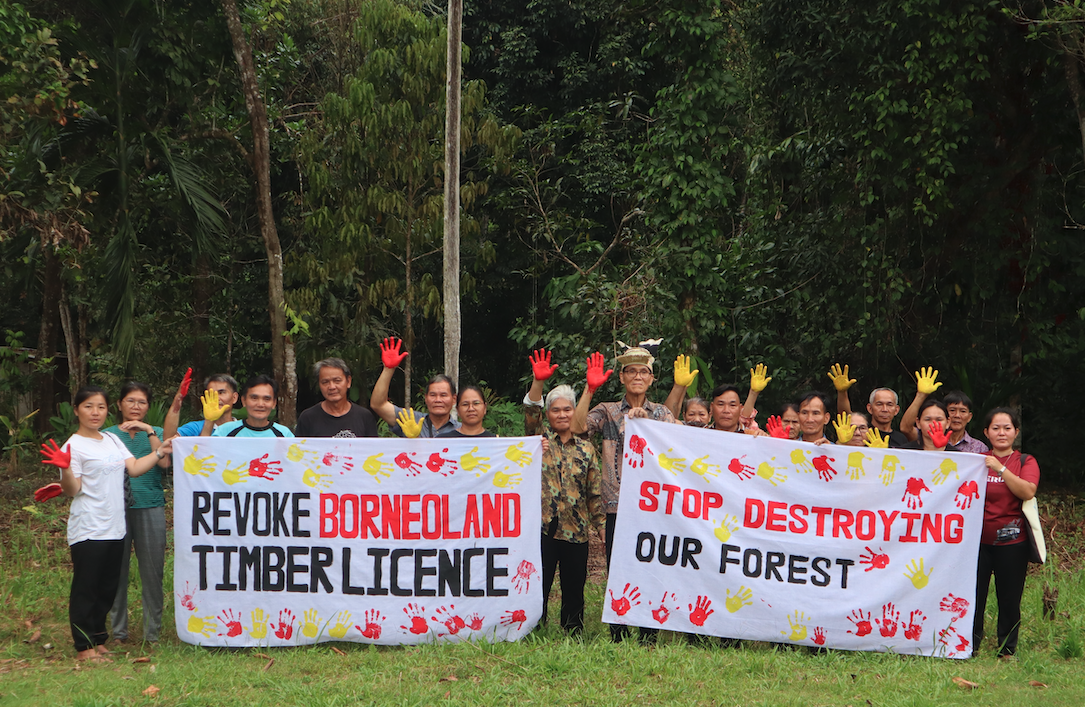
Upper Baram, Sarawak — Penan and Kenyah communities in the Upper Baram region of Sarawak, Malaysia have issued a strong and unified statement opposing any logging activities in their ancestral lands. “We call on the Sarawak Government to adopt a zero-logging policy immediately”, emphasizes Roland Engan, Indigenous peoples rights lawyer.
In a letter sent to the Sarawak Premier, the Forest Department Sarawak (FDS), and Borneoland Timber Resources Sdn. Bhd. (“Borneoland”), seven communities (Long Moh, Long Semiyang, Lio Mato, Long Siut / Long Tungan, Long Sepigen, Long Kerong, Long Sait) have rejected all activities carried out on their Native Customary Rights (NCR) land without their consent. According to the communities they have not received any response to their formal letter outlining these concerns and objections, delivered at the end of March.
Logging activities in the Upper Baram by Borneoland began in late 2023 and continue despite legal actions, human rights concerns, large-scale environmental degradation, and protest by impacted communities. Although forest certification is required for all Sarawak timber concessions under the Malaysian Timber Certification Scheme, Borneoland continues to operate without such certification.
Communities also report that surveys appear to have been conducted without Free, Prior and Informed Consent (FPIC), further deepening mistrust toward both the company and relevant authorities. They state unequivocally that they do not consent to any such activities. Further, they refuse to hold negotiations with Borneoland and FDS on their territories, signalling that these parties are not welcome to enter.
The resistance letter, signed by representatives of the communities, also raises concerns about divisive practices. This includes the alleged meetings and negotiations with selected or externally appointed community leaders only, without consulting the majority of the community for their consent. “The Penan and Kenyah people reject this approach. Legitimate representation must come from collectively recognized and elected community leaders, not government appointed leaders that fail to represent the community”, says Komeok Joe, director of the Indigenous organization Keruan.
The communities’ concerns point to a stark contradiction between ongoing logging pressures on the ground and the Sarawak government’s recently articulated “Beyond Timber” strategy, which presents forests as strategic assets for carbon storage, biodiversity conservation, ecosystem services, and sustainable livelihoods. While Sarawak promotes a transition toward a green economy, the reality faced by the Indigenous communities in Upper Baram is one of continued encroachment, opaque surveys, and the threat of forest degradation.
“The Sarawak Government should no longer allow logging activities without the free, prior and informed consent. Forests should remain in the hands of their true custodians. There should be no more logging, regardless of whether it is labelled sustainable or reduced-impact logging, says Roland Engan, Indigenous peoples rights lawyer. He also calls for an immediate zero-logging policy, saying rural communities should no longer rely on logging companies for road access now that the government plans to upgrade logging roads.
“Such practices undermine the very environmental and economic values the government claims to uphold, and risk eroding both biodiversity and Indigenous stewardship that are essential to any credible green development agenda,” explains Celine Lim, managing director of SAVE Rivers.
Through this joint statement, the communities of Long Moh, Long Semiyang, Lio Mato, Long Siut / Long Tungan, Long Sepigen, Long Kerong and Long Sait here firmly reaffirm their rejection of any logging activities by Borneoland within their area.
The Indigenous communities call on all relevant parties to respect their decisions, uphold Indigenous rights, and immediately cease any actions that violate their autonomy and land rights.
Photo credit: Bruno Manser Fund